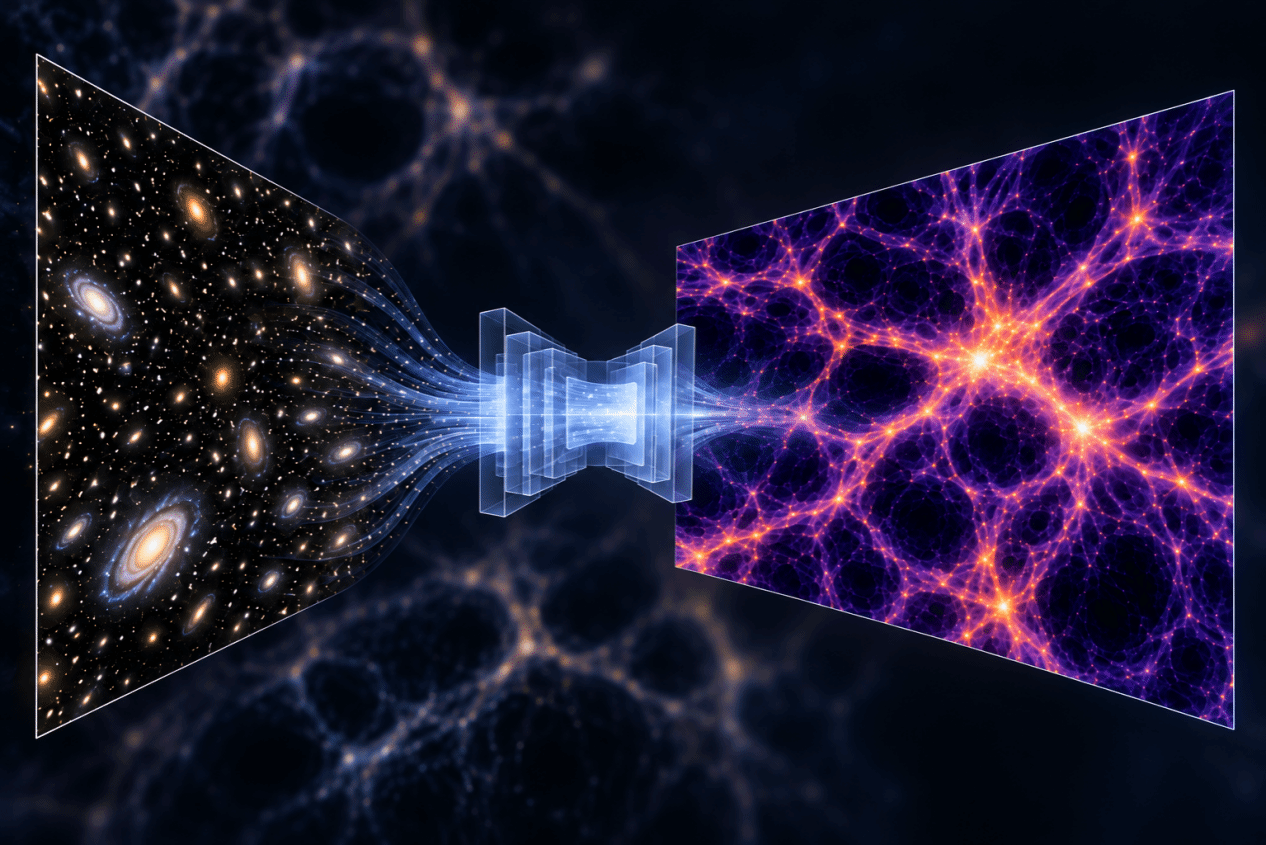
A research team led by Professor Yingjie Peng at the Kavli Institute for Astronomy and Astrophysics, Peking University, has developed a generative diffusion model to reconstruct the dark matter density field across scales of approximately 0.1–100 Mpc. Applying this approach to real galaxy observations from the Sloan Digital Sky Survey (SDSS) for the first time, the team revealed dark matter structures ranging from individual galaxy halos to the large-scale cosmic web. This breakthrough extends diffusion-model-based reconstruction from cosmological simulations to real observations, opening new possibilities for mapping dark matter and studying galaxy evolution with future surveys, including the China Space Station Telescope (CSST). The study was published in The Astrophysical Journal Letters, with Peking University PhD student Kunyao Zhao as the first author and Professor Yingjie Peng as the corresponding author.
Dark matter accounts for approximately 85% of all matter in the Universe and provides the dominant gravitational influence driving the formation and evolution of cosmic structures. Galaxies form within dark matter halos, which, together with the filamentary structures connecting them, make up the vast cosmic web. Accurately characterizing the spatial distribution of dark matter is therefore essential for understanding the large-scale structure of the Universe and the formation and evolution of galaxies. However, because dark matter cannot be observed directly, inferring the unseen structures underlying the distribution of visible galaxies remains a major challenge in modern astrophysics.
Recent advances in generative artificial intelligence have offered a new way to address this challenge. By learning complex statistical distributions, diffusion models can generate spatial structures with highly nonlinear features, making them promising tools for reconstructing the cosmic dark matter distribution. To adapt this technique to real astronomical observations, the team developed a conditional diffusion-model framework that uses only galaxy positions and stellar masses—quantities measurable in galaxy surveys—as inputs, allowing the AI model to infer the underlying dark matter density field from the observed galaxy distribution. The team trained the model using the CAMELS cosmological simulations and validated it independently with the IllustrisTNG300-1 simulation. The results demonstrate robust reconstruction performance across different simulations: the scatter in reconstructed dark matter halo masses is less than 0.2 dex, while the typical scatter in projected dark matter surface mass density on scales of around 100 kpc is approximately 0.3 dex. Further statistical tests show that dark matter halo masses derived from the reconstructed field are broadly consistent with estimates from existing group catalogs, and that the halo mass function agrees with expectations from cosmological simulations, supporting the reliability of the results.
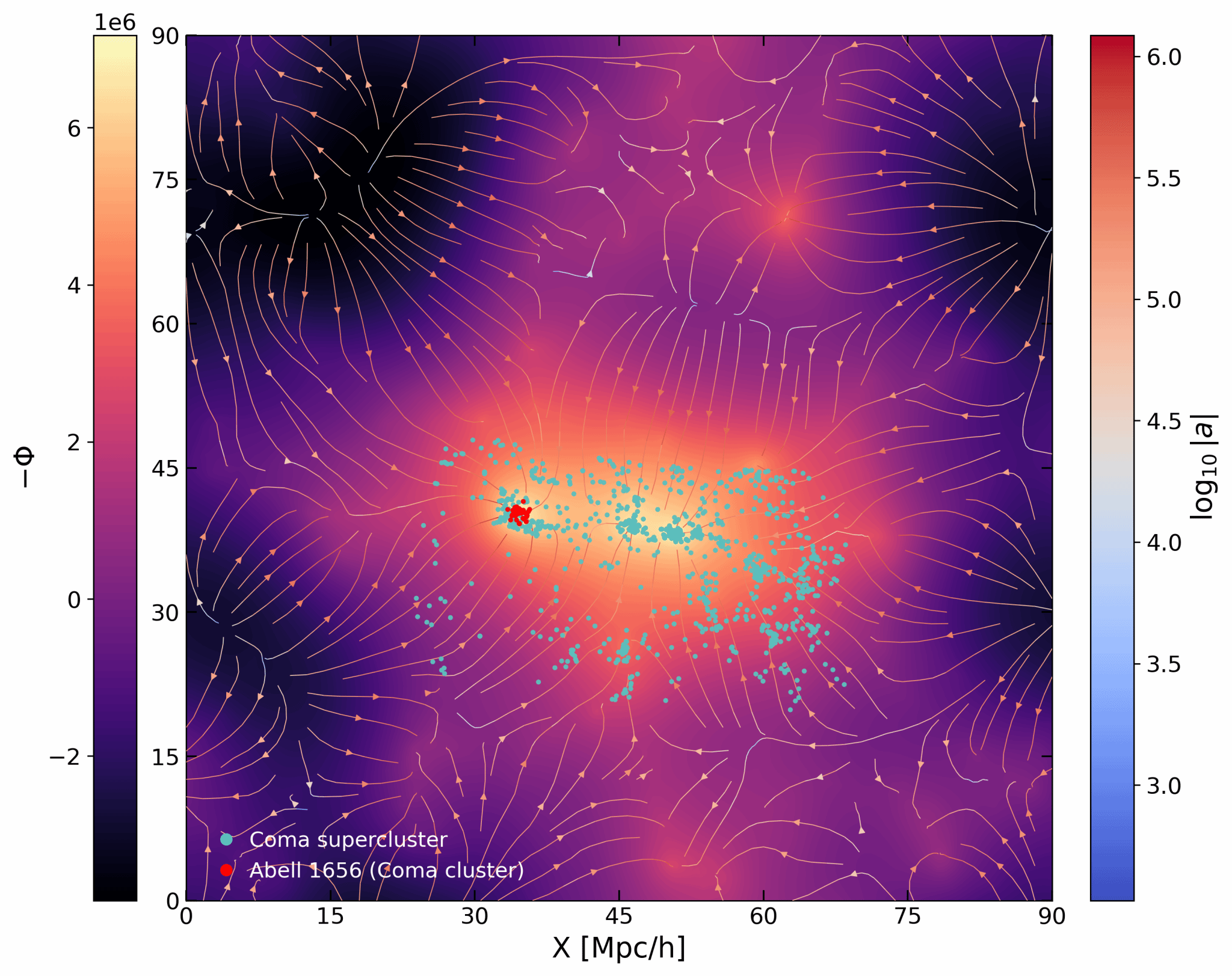
Building on these tests, the researchers applied the framework to real SDSS galaxy observations for the first time, producing a two-dimensional map of the projected dark matter distribution covering approximately 90 × 90 (Mpc/h)² at a spatial resolution of 0.097 Mpc/h (Figure 1). The reconstruction clearly reveals structures across multiple scales, from dark matter halos to galaxy clusters, cosmic filaments, and voids, in good agreement with the distribution of known galaxy groups and clusters. The team also derived the large-scale gravitational potential from the reconstructed dark matter field. The Coma Cluster lies within one of the deepest gravitational potential wells in the mapped region, demonstrating that the method can recover not only local dark matter overdensities but also important physical information about the large-scale gravitational field.
Traditional studies of galaxy environments have primarily relied on indirect indicators, such as the spatial density of visible galaxies. The reconstructed dark matter field could allow researchers to characterize the dark matter distribution surrounding galaxies and their large-scale gravitational environments more directly, enabling deeper investigations into the physical connections among dark matter halos, cosmic large-scale structure, and galaxy formation and evolution. As next-generation surveys—including DESI, LSST, and China’s CSST—provide increasingly rich galaxy observations, this new method is expected to find wider applications. In particular, CSST’s wide field of view, high spatial resolution, and multiband observing capabilities could supply abundant high-quality data for AI-driven dark matter reconstruction. By extending the method to larger cosmic volumes and three-dimensional reconstruction, future work may enable more detailed and extensive maps of dark matter, opening new avenues for investigating the physical mechanisms underlying cosmic structure formation and galaxy evolution.
Figure 1 | A two-dimensional map of the projected dark matter density field in the nearby Universe, reconstructed from SDSS galaxy survey observations using generative artificial intelligence. The reconstruction reveals multiscale structures, including galaxy clusters, cosmic filaments, and voids. (Figure 3 in the paper.)
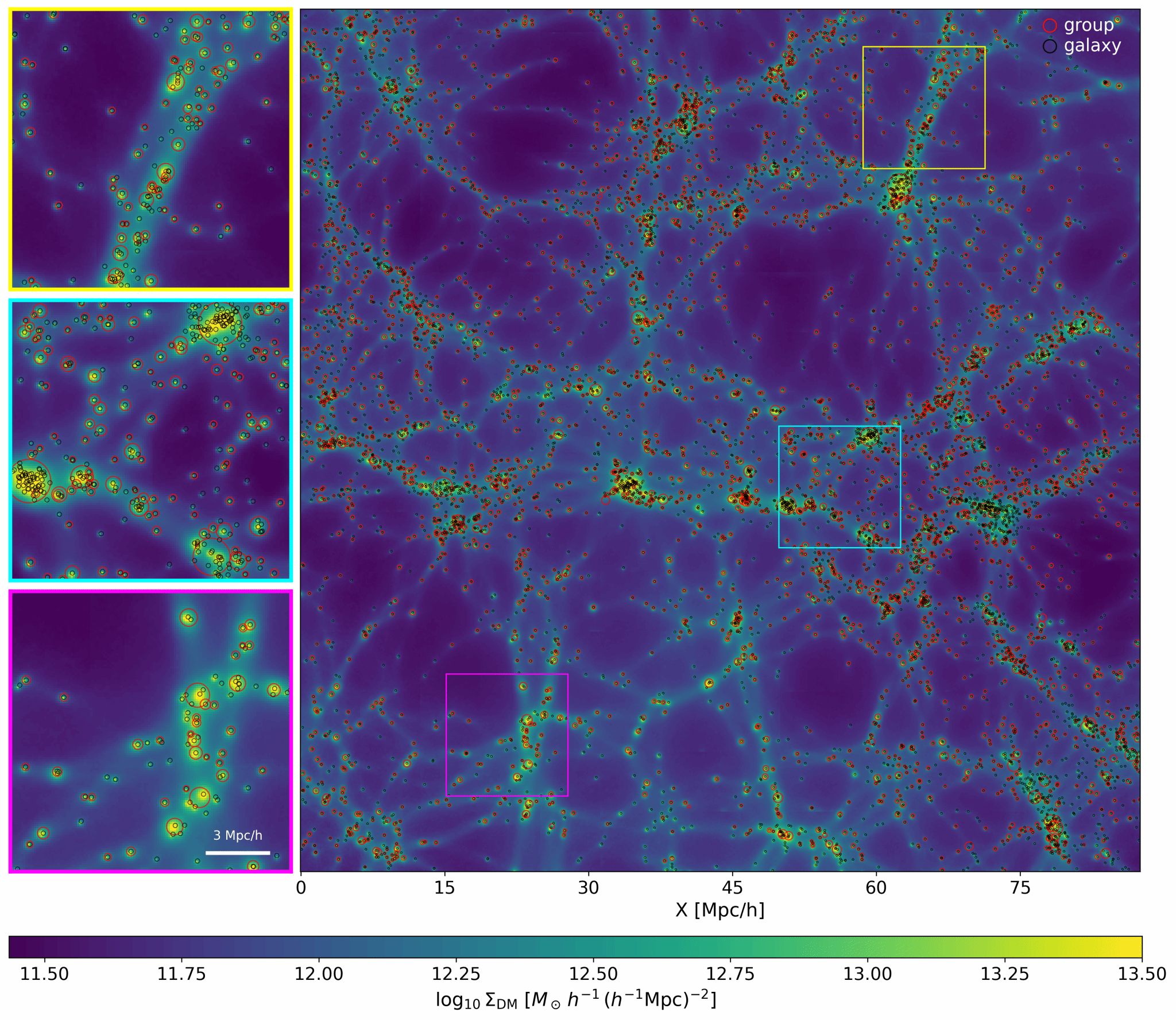
Figure 2 | The large-scale gravitational potential derived from the reconstructed dark matter field. The Coma Cluster lies within one of the deepest gravitational potential wells. (Figure 5 in the paper.)
Research paper and online link:
Reconstructing the Projected Dark Matter Field across 0.1–100 Mpc Scales from the SDSS Survey
The Astrophysical Journal Letters (2026)
https://doi.org/10.3847/2041-8213/aea8fe
