The gamma-ray burst GRB 221009A, which erupted on October 9, 2022, is known as the brightest GRB of all time. Recently, a team co-led by Prof. Zhuo Li of the Department of Astronomy, School of Physics and the Kavli Institute for Astronomy and Astrophysics, Peking University, and PhD student Ruize Shi discovered an additional spectral component near 2 MeV (10 billion K) during the brightest phase of the event and further confirmed a narrow emission line whose energy was about 40 MeV at early times. Drawing on these two new findings, the Peking University team examined how energy was divided between the burst’s hot fireball and magnetized jet, presenting a new argument that the jet’s energy was dominated by magnetic fields. The work, including collaborations with Prof. Xinqiao Li of Institute of High Energy Physics, Chinese Academy of Sciences and a team in Italy, was published in The Astrophysical Journal Letters.
Detailed observations of GRB radiation in the MeV–GeV band are usually lacking because of limitations in detector sensitivity. However, GRB 221009A was so bright that most gamma-ray detectors suffered from saturation and other observational problems. The collaboration successfully used unsaturated data from the space monitoring of high-energy particles with HEPP-H aboard the CSES-01 (Zhangheng-1) satellite to reconstruct the burst’s high-energy gamma-ray spectrum from 2 to 255 MeV. The analysis found a pronounced spectral bump near 2 MeV in addition to the usual Band-function continuum at the peak of the main burst. This is the first time this bump has been found in a GRB spectrum.
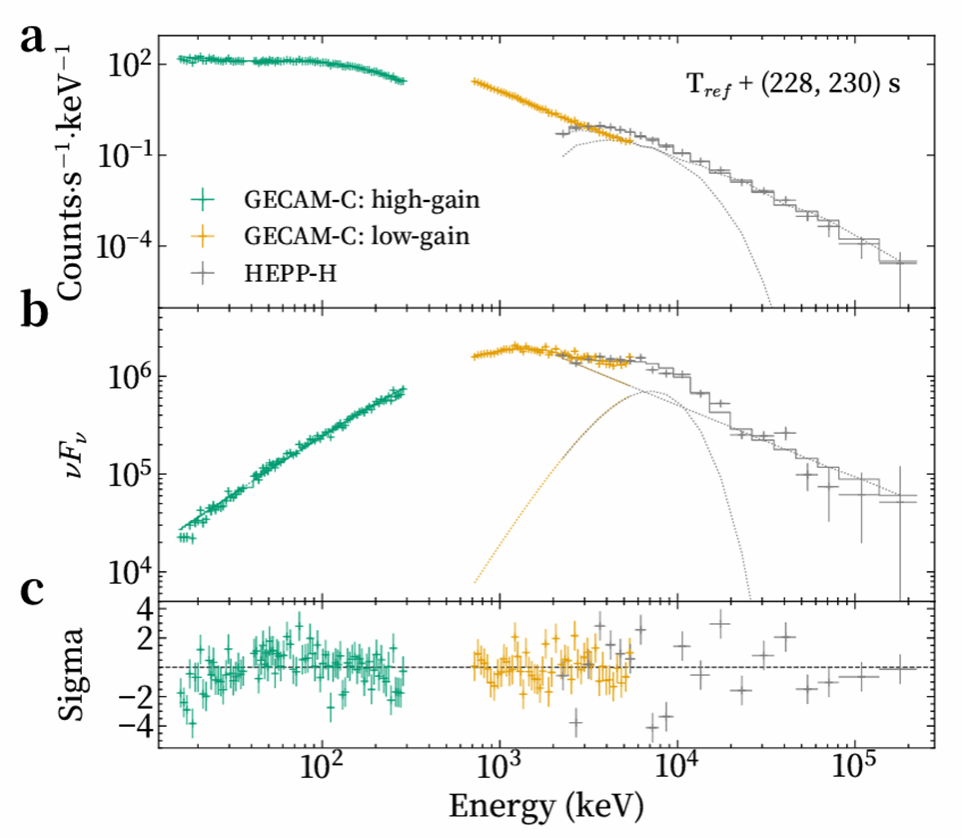
Figure 1. Joint spectrum during the peak of the main burst. GECAM-C and HEPP-H data reveal an additional spectral component in the MeV band. Credit: Ding et al., Figure 2(a–c) of the paper.
The Peking University team’s theoretical analysis of this new component found that the only plausible explanation is that of an initial GRB ‘fireball.’ Thermal components have been detected in many GRB spectra, but their temperatures have been a few hundred keV or less. The temperature of about 2 MeV in this event offers a new clue to the GRB central engine. When the central engine starts, it may form an extremely hot, opaque fireball. As the fireball expands and accelerates, it gradually becomes transparent, allowing the thermal photons trapped within it to escape from the so-called ‘photosphere.’ Usually this radiation is released only after the fireball has stopped accelerating, when expansion has already lowered its temperature considerably. The exceptionally high temperature of about 2 MeV suggests that the photons may instead have escaped during the acceleration phase, retaining information about the fireball’s initial temperature. Under this interpretation, the observed thermal radiation keeps most of the energy of the fireball itself, yet accounts for only about 6% of the burst’s total gamma-ray energy. This means that the fireball is only a secondary energy component of the jet, while most of the energy is carried by another, stronger component that may be highly magnetized.
The team also revealed a narrow emission line during the burst’s decay phase, with an early central energy of about 40 MeV. The new data trace this previously detected line to earlier times and higher energies and show that its central energy decreases approximately as an inverse power law with time while its flux first rises and then falls.
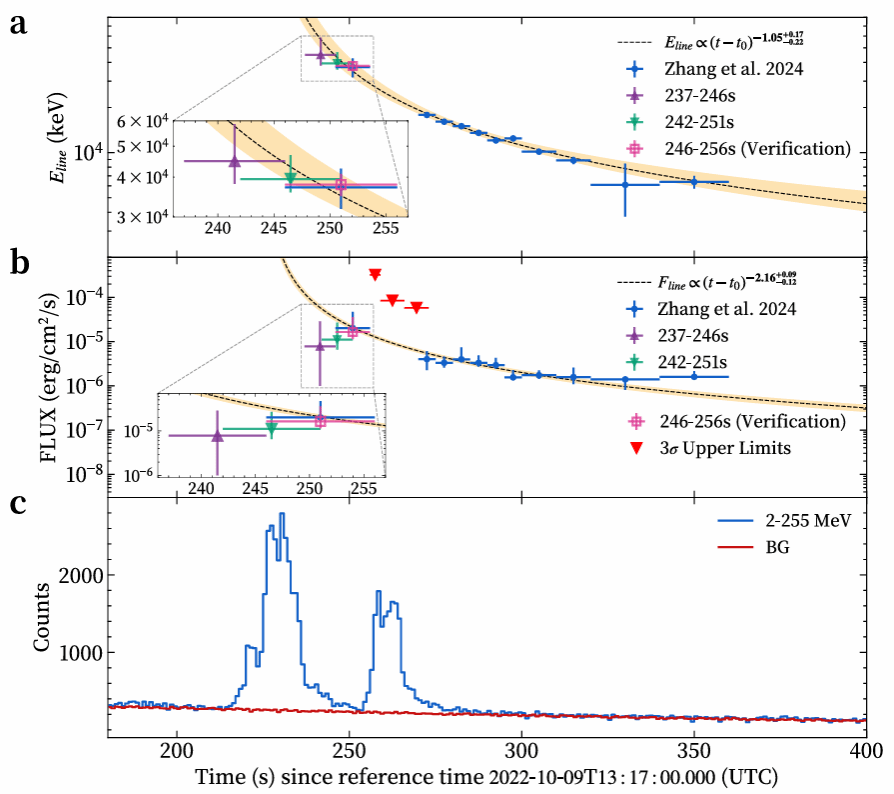
Figure 2. Temporal evolution of the emission line. The upper and middle panels show the declining central energy and the flux’s initial rise and subsequent fall, respectively; the lower panel shows the high-energy count rate. Credit: Ding et al., Figure 3 of the paper.
The most natural origin of the line is the annihilation of electron–positron pairs produced by the absorption of high-energy GRB photons. When an electron and a positron meet, they can release 511 keV photons. Relativistic Doppler boosting by the fast-moving jet can raise their observed energies into the tens-of-MeV range. Radiation from different directions on the jet surface reaches Earth at different times. Photons arriving later receive less Doppler boosting, so the line’s central energy falls approximately as an inverse power law with time. This ‘curvature effect’ naturally explains the line’s energy evolution without fine-tuning the model.
The observed line is also quite narrow, with a width of about 10% of its central energy. If electron–positron annihilation produces it, the particles must cool rapidly before they annihilate. The Peking University team pointed out that inverse-Compton radiation from pairs scattering GRB photons cannot cool them quickly enough, requiring an additional cooling mechanism. Synchrotron or cyclotron radiation in a strong magnetic field could provide that cooling. The emission-line properties and the 2 MeV bump therefore point independently to the existence of a jet dominated by magnetic energy. The team further suggested that the line flux’s rise-then-fall behavior may indicate a ring-shaped jet structure, where the magnetic field and line emission are weaker near the jet axis and stronger toward the edges.
From a hot photosphere to a magnetized jet and an emission region with angular structure, the study connects two rare spectral features in a physical picture of GRB 221009A’s central engine and jet. The available MeV–GeV data offer new clues to how GRBs divide and release their energy.
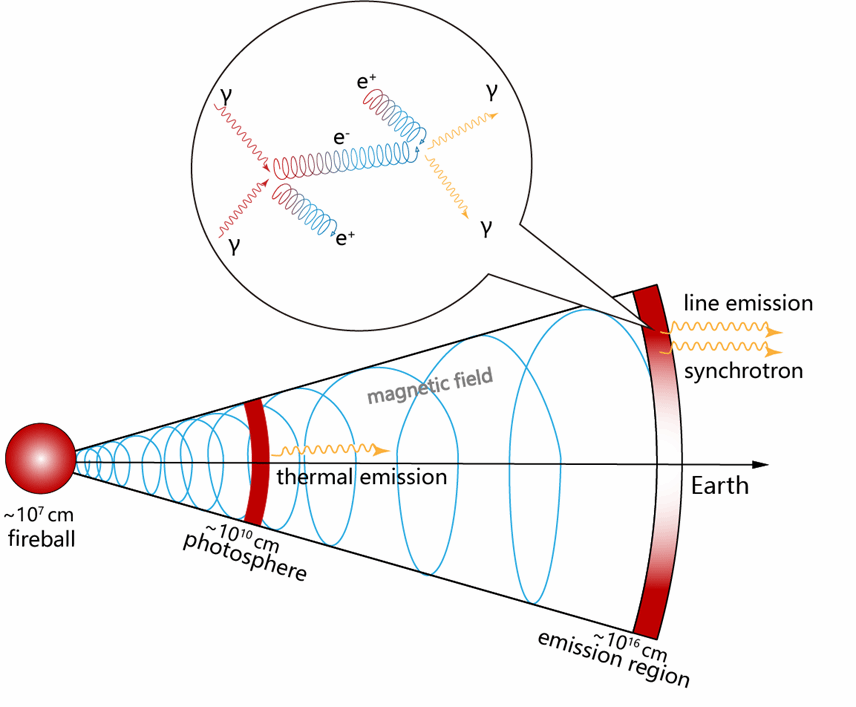
Figure 3. Schematic of the physical processes proposed in the paper. The photosphere releases thermal radiation closer to the central engine; farther out, the magnetized jet produces nonthermal radiation and may generate the line through the cooling and annihilation of electron–positron pairs. The diagram presents a theoretical interpretation. Credit: Ding et al., Figure 4 of the paper.
Paper: Detection of 2 MeV spectral bump and ~40 MeV emission line from GRB 221009A
Link: https://doi.org/10.3847/2041-8213/aeba80
