The Milky Way’s last major merger with a dwarf galaxy helped shape its early structure, but the timing of this last merger has remained uncertain. Using a new method based on the ages of ancient stars, astronomers have dated this event to about 10.1 billion years ago. The result provides the most precise estimates yet for when the last major merger occurred and helps to establish a clearer timeline for the Milky Way’s early evolution.
The study was published in The Astrophysical Journal Letters by first author, Sihan Lu, a PhD student at Peking University, corresponding authors Associate Professor Yang Huang of the National Astronomical Observatories of the Chinese Academy of Sciences and Professor Huawei Zhang of Peking University, and coauthor Qikang Feng, a PhD student at Peking University.
The Milky Way's Last Major Merger
In the hierarchical picture of galaxy formation, massive galaxies form and evolve through the continued accretion of smaller systems. The stellar halo and disk of the Milky Way still preserve dynamical and chemical signatures of these early accretion events. Among them, the Gaia-Sausage-Enceladus (GSE) merger is widely regarded as the last major merger experienced by the Milky Way and was a key event in shaping the stellar halo and early disk of our galaxy.
Astrometric data from Gaia, a European Space Agency satellite designed to conduct a large-scale survey of stars across the Milky Way, had previously revealed a population of Galactic halo stars on strongly radial orbits, producing an elongated, “sausage-like” distribution in velocity space. These stars are thought to originate from a dwarf galaxy that fell into the early Milky Way and was tidally disrupted roughly 10 billion years ago. This kinematic structure is commonly associated with the Gaia-Sausage/Enceladus merger remnant. The merger deposited accreted stars into the Milky Way and dynamically heated the disk that had already formed. Some stars originally moving on nearly circular disk orbits were scattered onto low-angular-momentum, halo-like orbits. This in-situ population, subsequently heated by the merger, is commonly known as the Splash.
Accurately determining the GSE merger epoch is essential for reconstructing the Milky Way's early accretion history, the formation of its thick disk, and the dynamical evolution of its disk. Previous studies based on the relationships between stellar kinematics/chemical abundances and stellar ages, and the ages of globular clusters associated with GSE generally placed the merger between 8 and 11 billion years ago. Uncertainties in stellar ages and sample selection, however, left a relatively broad allowed interval.
The Splash and Thick-disk Age Distributions
In the standard picture, the Splash formed mainly when the GSE merger dynamically heated the early thick disk. Splash progenitors and pre-merger thick-disk stars therefore came from the same parent population and should have shared the same intrinsic age distribution. Observations, however, show that the Splash distribution is shifted toward older ages, with a peak about 0.3 billion years earlier than that of the thick-disk star-formation history.
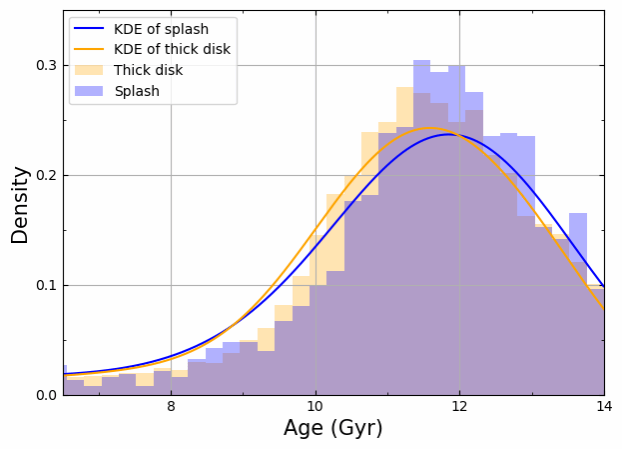
Figure 1. Age distributions of thick-disk and Splash stars. Most stars in both populations formed more than 10 billion years ago. The Splash contributes a larger fraction at the high-age end, and its age distribution peaks at an older age than that of the thick disk.
During the merger, some pre-existing thick-disk stars were heated onto low-angular-momentum, halo-like orbits and became part of the Splash. Thick-disk stars formed later did not undergo this process. The merger therefore truncated the young-age end of the intrinsic Splash age distribution, while thick-disk star formation continued.
Stellar-age uncertainties broaden intrinsic age distributions through convolution. This has little effect on the peak of the approximately symmetric thick-disk distribution. For the truncated Splash distribution, however, convolution systematically shifts the observed peak toward older ages, producing an Eddington-like bias. The shift depends on the merger epoch. Comparing predictions for different epochs with the observed shift therefore provides a quantitative constraint on the GSE merger epoch.
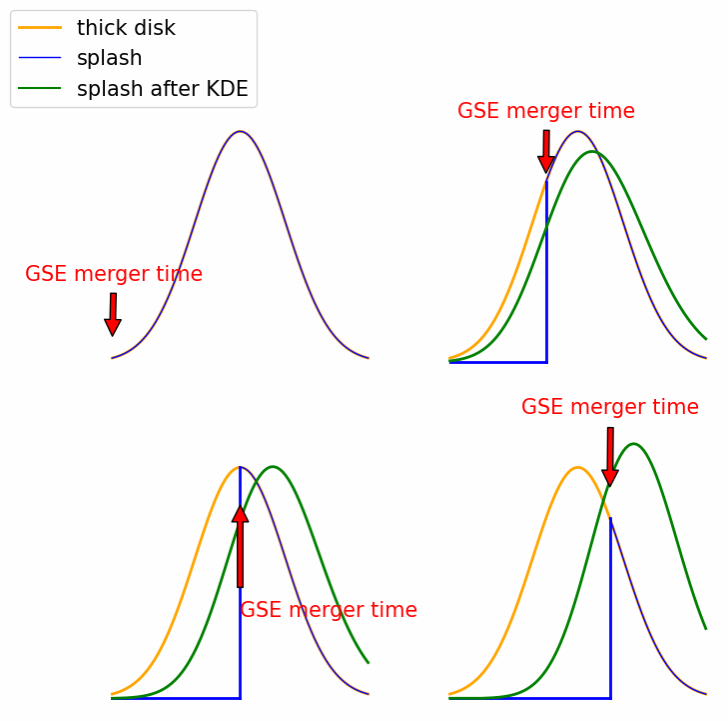
Figure 2. Truncation of the age distribution and the peak-shift mechanism. Before the merger, the intrinsic Splash age distribution (blue) is identical to that of the contemporaneous thick-disk population (orange). The merger truncates the young-age end of the Splash distribution. After convolution with stellar-age uncertainties, the peak of the observed Splash distribution (green) shifts toward higher ages. Different merger epochs produce different peak shifts.
Constraint on the GSE Merger Epoch
The study used the subgiant catalog constructed by Xiang & Rix (2022). Combining LAMOST DR7 spectroscopy with Gaia EDR3 astrometry, the parent catalog contains 247,104 subgiants, 73% of which have relative age uncertainties below 10%. The high age precision of this sample provides the basis for measuring the age distributions of the thick disk and Splash.
Using this mechanism, the team modeled a sequence of possible GSE merger epochs. For each epoch, they truncated the young-age end of the intrinsic Splash age distribution and convolved it with the observed age-error distribution. This mapped the merger epoch to the resulting peak shift. The team propagated individual age uncertainties through 10,000 Monte Carlo realizations. Comparing the model relation with the observed shift yielded a GSE merger epoch of 10.1 ± 0.2 billion years ago. An independent analysis of the number ratio between Splash and thick-disk stars placed the merger at approximately 10–11 billion years ago, consistent with the peak-shift result.
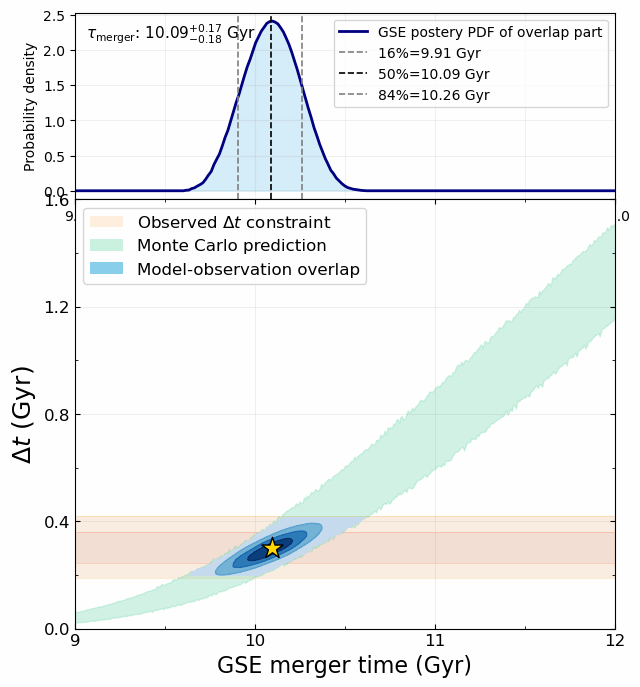
Figure 3. Joint constraint on the GSE merger epoch from the age-peak offset. The green region shows the peak offsets produced for different merger epochs in the Monte Carlo model, while the orange region represents the observational constraint. Their overlap defines the parameter range consistent with the data. The upper panel shows the posterior distribution of the merger epoch, with the best-fitting value at approximately 10.1 billion years ago.
Scientific Significance and Model Scope
Compared with previous estimates, this study improves the precision of the GSE merger-epoch constraint by a factor of approximately five. The result provides a sharper timeline for the end of the Milky Way's early major-accretion phase, thick-disk formation, and subsequent disk evolution.
This estimate relies on a model in which the GSE merger truncates the Splash age distribution and stellar-age uncertainties shift its observed peak toward older ages. The analysis approximates the thick-disk star-formation history with a Gaussian distribution and treats the merger as an instantaneous truncation event. It also adopts the standard picture in which the Splash formed primarily through GSE-induced heating of the thick disk. Other processes, including scattering by massive clumps in the early disk and the formation of stars on dynamically hot orbits, may produce similar populations.
Individual stellar ages have uncertainties of approximately 10%. Even so, the collective age distribution of a large sample can date an event more than 10 billion years ago to a precision of about 0.2 billion years. Measurement uncertainties are usually treated as noise to be minimized. Here, however, a physical event changes a distribution boundary, and those uncertainties reshape the observed distribution in a predictable way. Modeling this response turns the distributional change into a measurable signal for inferring physical parameters.
In the future, Gaia DR4 and asteroseismology will provide larger datasets, more precise stellar ages, more complete kinematic information, and cleaner stellar-population samples. These data will enable stronger tests of the model assumptions and tighter constraints on the GSE merger epoch.
This work was supported by the National Key R&D Programme of China (grant Nos. 2025YFF0510603, 2024YFA1611903, and 2023YFA1608303), the National Natural Science Foundation of China (grant No. 12422303), and the Fundamental Research Funds for the Central Universities.
Publication
Lu, S., Huang, Y., Feng, Q., & Zhang, H. 2026, “The Epoch of the GSE Merger: Insights from the Splash and Thick-disk Age Distributions,” The Astrophysical Journal Letters, 1006, L40.
Link:https://doi.org/10.3847/2041-8213/ae853d
