On megaparsec scales, dark matter and galaxies are distributed throughout a vast and intricate network known as the cosmic web. Dense regions form nodes, while elongated filaments connect them across millions of lightyears. These filaments provide important channels for the transport and accretion of matter toward dense regions and are closely connected to the formation and evolution of galaxies. Yet, unlike dark-matter halos, which have been extensively studied, cosmic filaments have neither clearly defined boundaries nor an obvious characteristic scale. How their internal structure is organized has therefore remained difficult to describe quantitatively in a unified way.
A recent study led by Fangzhou Jiang, Assistant Professor at the Kavli Institute for Astronomy and Astrophysics at Peking University provides a systematic characterization of the internal structure of cosmic filaments across different cosmic epochs and physical scales. Using the high-resolution cosmological hydrodynamical simulation TNG50 from the Illustris-TNG project, the team investigated the radial dark-matter density profiles of cosmic filaments. Their paper, “Universal Dark-matter Density Profiles of Cosmic Filaments,” has been published in The Astrophysical Journal Letters. Peng Xu, a former undergraduate student at Zhili College, Tsinghua University, and currently a master’s student in the Department of Physics and Astronomy at Northwestern University, is the first author of the paper.
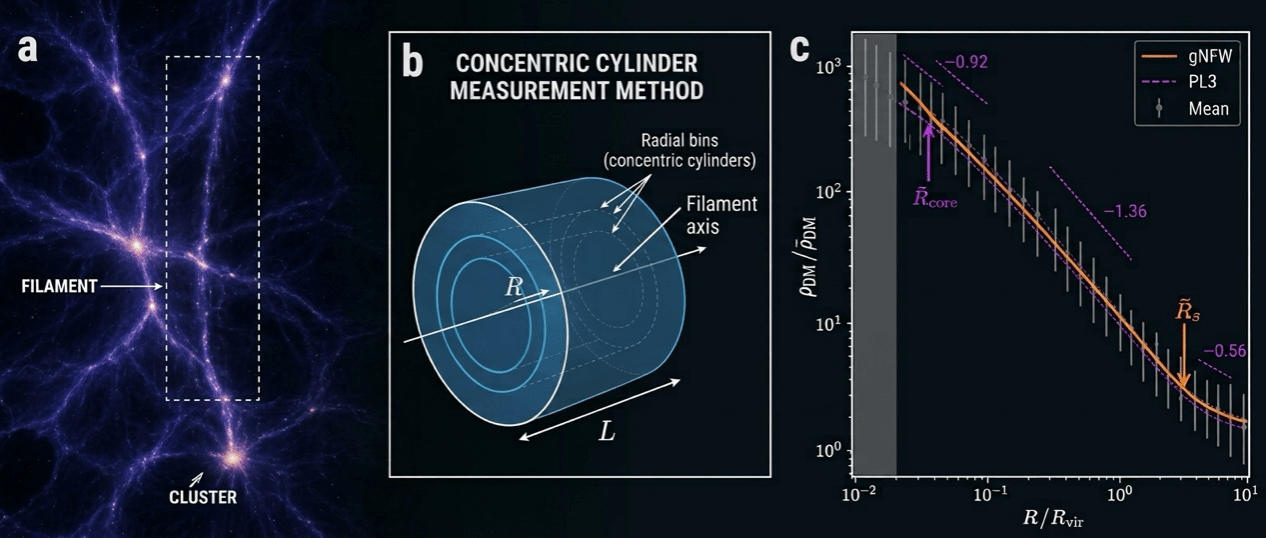
Figure 1 | (a) Illustration of the cosmic web; (b) definition and measurement of the radial density profile of a filament; (c) filament density profiles normalized by the virial radius of the connecting nodes, together with the best-fitting model. The dotted lines indicate the power-law slopes of the PL3 model at three characteristic radii.
A New Way to Define the Center of Cosmic Filaments
The team first addressed a seemingly simple but fundamental question: How should the center of a cosmic filament be defined?
Conventional analyses often use the filament spines identified by the topological algorithm DisPerSE from an input density field. However, because the input density field is sampled on a finite-resolution grid, the extracted spine does not necessarily coincide with the actual density ridge of the underlying matter distribution. To address this issue, the researchers developed an iterative “shrinking-cylinder” re-centering algorithm. Starting from the filament spine identified by DisPerSE, they construct a cylindrical region around the spine, repeatedly shrink the cylinder, and recalculate the local center of mass. This process gradually shifts the filament spine toward a position that better follows the underlying density distribution.
The re-centering procedure has a substantial impact on the inferred internal structure of filaments. After re-centering, the inferred dark-matter density in the central regions increases by approximately 1-1.5 orders of magnitude. This demonstrates that accurately locating the filament spine is an essential prerequisite for measuring the internal dark-matter structure of cosmic filaments.
A Universal Density Profile Across Cosmic Time and Scale
With more reliable filament centers established, the researchers compared the radial dark-matter density profiles of filaments across different redshifts, node masses, and filament lengths.
A key finding is that the density profiles of different filaments can differ substantially when expressed in terms of physical distance. However, when the radial distance is normalized by the virial radius of the dark-matter halos at the filament endpoints, the profiles become remarkably universal. In other words, the scale of the dark-matter halos connected by a filament provides a natural radial scale for describing its internal structure.
This near-universality persists across different cosmic epochs, as well as across a broad range of node masses and filament lengths. The researchers further modeled the universal profile using a generalized triple-power-law (PL3) model. The model captures the distinct structural regimes of filaments from their centers to their outskirts: a relatively shallow inner region, followed by an intermediate power-law regime, and a more slowly declining outer component.
From Smooth Accretion to Clumpy Structure
After establishing the near-universal radial density profile, the team investigated its physical origin by separating dark matter bound within halos from the unbound, smoothly distributed dark matter component.
The results show that removing halo-bound dark matter substantially lowers the density in the central regions of filaments. This indicates that the high central density of the full filament profile is largely associated with low-mass dark-matter halos embedded along the filament spines.
The result also provides insight into how filamentary structures may evolve. At earlier times, matter accretion onto nodes is more dominated by a relatively smooth component. As low-mass dark-matter halos progressively form within filaments, an increasing fraction of the matter becomes organized into halos before reaching the nodes, leading to increasingly clumpy accretion at later cosmic times.
What Filament Structure Reveals About Galaxy Formation
This study establishes a unified framework for describing the internal dark-matter structure of cosmic filaments across different cosmic epochs and physical scales. Although filaments lack the well-defined boundaries and natural characteristic scales of dark-matter halos, their internal structure can be effectively normalized using the virial radius of their connecting nodes, revealing a nearly universal radial dark-matter density profile.
These findings provide a new perspective on the transport of matter through the cosmic web, the formation of dark-matter halos, and the environments in which galaxies form and evolve. In future work, the research team plans to investigate cosmic filaments using cosmological simulations with larger volumes and higher resolution, while also connecting the theoretical filamentary structures to cosmic-web reconstructions based on observations. Such studies may help clarify how the cosmic web regulates the formation and evolution of galaxies.
This work was supported by the National Natural Science Foundation of China (NSFC) and the China Manned Space Program through the scientific research funding for the China Space Station Telescope (CSST).
Link to the Paper:
https://iopscience.iop.org/article/10.3847/2041-8213/aea298
