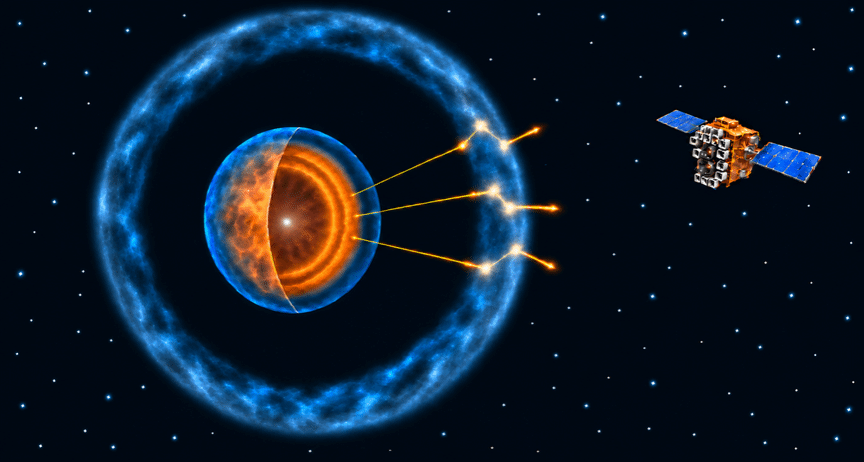
The first flash of a supernova carries important clues to the final moments of a star’s life. A team led by Prof. Zhuo Li at the Department of Astronomy, School of Physics, and the Kavli Institute for Astronomy and Astrophysics at Peking University has investigated the radiation produced by the two shocks that form when supernova ejecta interacts with a dense stellar wind. The study suggests that the reverse shock is an important source of the soft X-ray blackbody emission seen in shock breakout. The model naturally explains the thermal emission of EP260321a, an X-ray transient discovered by the Einstein Probe (EP) satellite, and provides a self-consistent physical picture for its X-ray light curve and early optical emission. The findings have been published in The Astrophysical Journal Letters.
When a massive star explodes as a supernova, a shock propagates outward, heating and ejecting stellar material. Once the trapped radiation can escape, it produces a brief, bright flash of ultraviolet or X-ray emission, a process known as shock breakout. If a dense stellar wind surrounds the star, breakout may occur in the wind rather than at the stellar surface. This short-lived phase can therefore reveal both the explosion itself and the mass ejection that preceded the star’s death.
Previous studies of wind breakout have generally focused on the forward shock sweeping outward through the wind. Li’s team also examined the reverse shock propagating back into the ejecta. Although this shock contains less internal energy, its lower speed relative to the upstream material makes it easier to establish local thermodynamic equilibrium and produce blackbody radiation. By comparison, the faster forward shock may produce higher-energy radiation that departs from a blackbody spectrum. Together, the two shocks provide a new theoretical framework for understanding the different radiation components of shock breakout. Figure 1 illustrates the two shocks and their surrounding environment.
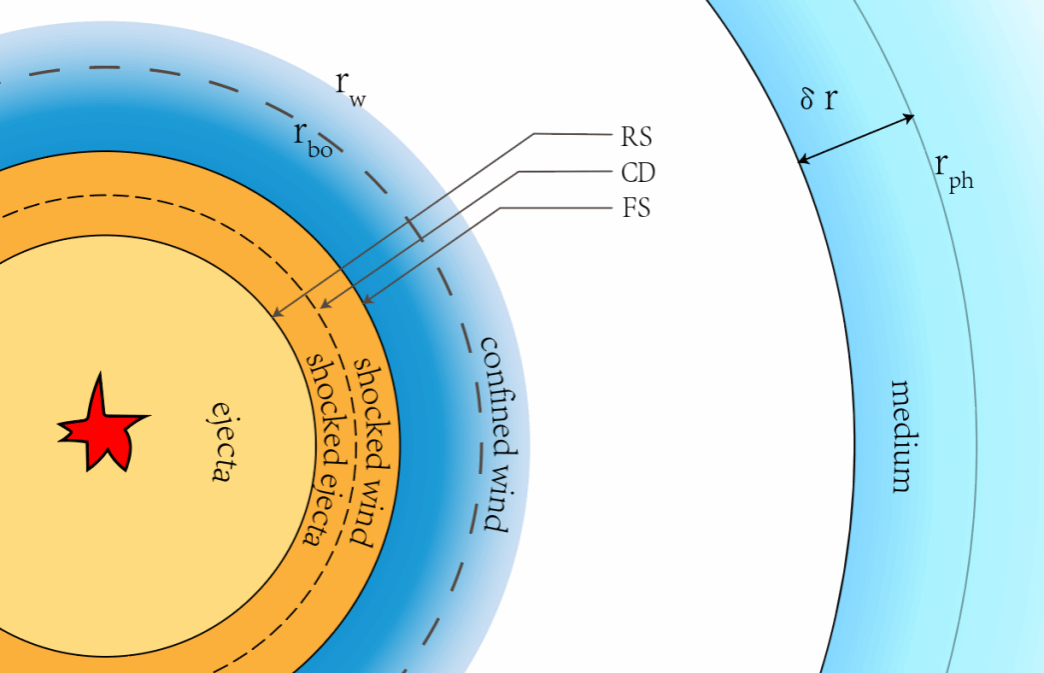
Figure 1. Schematic of supernova wind breakout showing the reverse shock (RS), contact discontinuity (CD), forward shock (FS), confined dense wind, and more distant scattering medium.
EP260321a provides an important test of this picture. Associated with the broad-lined Type Ic supernova SN 2026gzf, the event exhibits a soft X-ray blackbody spectrum with a temperature of about 0.13 keV. The study shows that the reverse shock can explain this thermal component when ejecta from a typical broad-lined Type Ic supernova interact with a dense wind. The model requires a wind mass of approximately one ten-thousandth of a solar mass, confined to a region close to the star at radii of roughly one trillion to ten trillion centimetres.
The study also shows that the light curve profile of the observed flash depends on how photons travel through the surrounding material, as well as on how the radiation is produced. Through Monte Carlo simulations, the team found that scattering in a more distant shell and differences in photon path lengths can stretch a brief flash into an extended decay tail, qualitatively reproducing the fast rise and slow decline of EP260321a’s X-ray light curve. Once this propagation delay is included, cooling emission from a shock-heated, expanding carbon–oxygen envelope can also account well for the event’s early multiband optical observations. Figure 2 compares the simulated X-ray light curves with the observations.
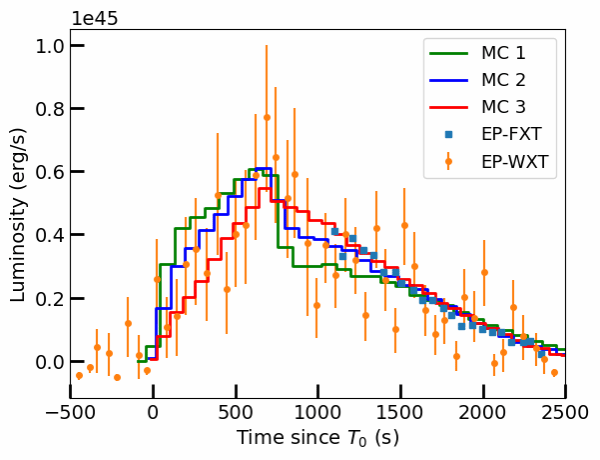
Figure 2. X-ray light curve of EP260321a comparing EP observations with the luminosity evolution from three Monte Carlo simulations.
The findings suggest that the forward and reverse shocks jointly shape the radiation from supernova wind breakout, and that the progenitor of SN 2026gzf underwent active mass ejection in the days to months before the explosion. The model also predicts a possible hard X-ray component in EP260321a beyond EP’s observing band. Future observations spanning both soft and hard X-rays will help test this double-shock picture and reveal more about the activity of massive stars before they explode.
The paper was authored by Zhuo Li, and PhD students Rui-Ze Shi and Qiang Wang of Peking University, with Zhuo Li serving as first and corresponding author.
Paper: Double-shock Radiation in Supernova Wind Breakout and EP260321a
Publication: Zhuo Li, Rui-Ze Shi, Qiang Wang, The Astrophysical Journal Letters, 1011, L41 (2026)
DOI: https://doi.org/10.3847/2041-8213/aeb6c1
